5 takeaways
- We should automate repeatable follow-up only after the sales process is clear.
- Automation is useful when enquiries are missed, delayed or handled inconsistently.
- High-value, complex or sensitive conversations still need human judgement.
- A good system can protect margins by reducing administration and improving consistency.
- Every sequence needs clear ownership, compliance checks and regular review.
Summary
Email follow-up automation can help us respond consistently, reduce missed opportunities and protect owner and team time. The right decision depends on enquiry volume, sales value, customer expectations, compliance, cashflow and capacity. Automation should handle repeatable steps while our people remain responsible for judgement, relationships and commercially important conversations.
Introduction
Manual follow-up can work when enquiry volumes are low and one person owns the process. As our business grows, it becomes easier for leads to sit unanswered or receive inconsistent messages. Automation can help, but only when the process is clear, the timing is appropriate and human judgement remains available.
How should we decide when to automate our email follow-up?
We should automate follow-up when a clear, repeatable process is becoming too time-consuming or unreliable to manage manually.
That means automating predictable actions such as acknowledgements, promised information, reminders and internal alerts while our people continue to handle judgement.
The process must come first. If we automate unclear wording, poor timing or weak ownership, we simply make the problem faster.
Our guide on how SMEs can use email to turn enquiries into customers explains the wider follow-up journey. Automation should support that journey, not become the entire sales strategy.
What signs show that manual follow-up is costing our business?
Manual follow-up becomes risky when it depends on memory.
Busy SME weeks already include payroll, delivery, VAT, recruitment and cashflow decisions.
Important enquiries can still sit unanswered while we deal with an urgent customer issue, approve supplier payments or prepare for payroll.
Warning signs include:
- Enquiries waiting too long for acknowledgement
- Quotes being sent without a planned follow-up
- Leads sitting in personal inboxes
- Different team members sending conflicting information
- Prospects receiving one message and nothing more
- The owner chasing every opportunity personally
- No clear record of why prospects did not proceed
This is where the real cost shows up.
We may have already spent money generating the enquiry through advertising, networking, content, referrals or sales activity. When follow-up is inconsistent, that investment is not being used properly.
We may also lose visibility over the sales pipeline. That makes it harder to forecast revenue, plan workloads or judge whether we can afford another hire.
A CRM often provides the shared visibility needed before automation begins. Our article on why SMEs need a CRM system explains how contact management, task tracking and sales visibility can create a more reliable process.
Which follow-up tasks should we automate first?
We should begin with frequent, low-risk actions that are easy to standardise.
1. Enquiry acknowledgements
An automatic acknowledgement can confirm that we have received the enquiry, explain what happens next and set a realistic response time.
This is especially useful when enquiries arrive outside working hours or during busy periods.
It should not pretend that a detailed review has already taken place. A clear message such as “We have received your enquiry and a member of our team will review it within one working day” is more useful than an exaggerated promise.
2. Internal reminders
Automation can remind the right person when a call, quote or follow-up is due.
This protects the process from being lost in an inbox or forgotten after a busy meeting.
Internal reminders can be particularly valuable where several people are involved in sales, estimating, finance or delivery.
3. Useful information
We can automatically send a relevant guide, case study, checklist or answer to a common question.
This helps the prospect understand the next step while reducing repetitive administration for our team.
The information still needs to match the enquiry. Sending a generic pack to every prospect may create more confusion rather than more clarity.
4. Meeting reminders
Automated reminders can confirm the time, access details and anything the prospect should prepare. This reduces missed meetings and avoids unnecessary back-and-forth.
5. Simple check-ins
A well-timed message can ask whether the prospect still wants to continue or whether priorities have changed. This gives them an easy way to respond without feeling chased.
Automation should stop where judgement begins.
A person should normally take over when:
- The enquiry is high value
- The work needs careful scoping
- Pricing is being negotiated
- Several decision-makers are involved
- Delivery capacity is uncertain
- The prospect raises a concern
- Payment terms or credit risk need to be reviewed
Software can acknowledge a major project enquiry, but it should not judge profitability, capacity or payment risk.
A clear website can also answer routine questions before the enquiry arrives. Our blog on what an SME website should prove before a buyer makes contact explains how better information can improve lead quality and reduce repetitive follow-up.
How can email automation affect cashflow, payroll and margins?
Automation does not create profit by itself.
Its value depends on whether it reduces avoidable administration, improves follow-up consistency or contributes to profitable conversions after software, implementation, training and management costs are considered.
A stronger follow-up process can help us:
- Respond more consistently
- Reduce missed enquiries
- Improve visibility over the sales pipeline
- Follow up quotes more reliably
- Identify poor-fit opportunities earlier
- Reduce repetitive administration
- Build more informed revenue forecasts
Any effect on conversion, revenue or cashflow should be measured using our own results rather than assumed.
We also need to calculate the cost properly.
The cost of employing someone includes more than their basic salary. We may also need to budget for employer National Insurance, workplace pension contributions, paid leave, benefits, training, payroll administration and the management time required to support the role.
As of June 2026, employers generally pay Class 1 secondary National Insurance at 15% on an employee’s earnings above the £5,000 annual Secondary Threshold. Different thresholds and zero-rate bands can apply to some employees, including qualifying apprentices, employees under 21, veterans and workers in eligible Freeport or Investment Zone roles. The current figures are available in the GOV.UK employer rates and thresholds.
If a system costs £300 a month but saves one hour, it may not improve our margin.
If it saves ten hours, prevents missed quotes and helps our team focus on commercially important conversations, the case may be stronger.
We should compare:
- Software and setup costs
- Training time
- Ongoing management
- Administrative time saved
- Changes in response time
- Changes in quote-to-sale conversion
- The margin on converted work
- The effect on customer experience
The goal is not to automate more.
The goal is to improve control.
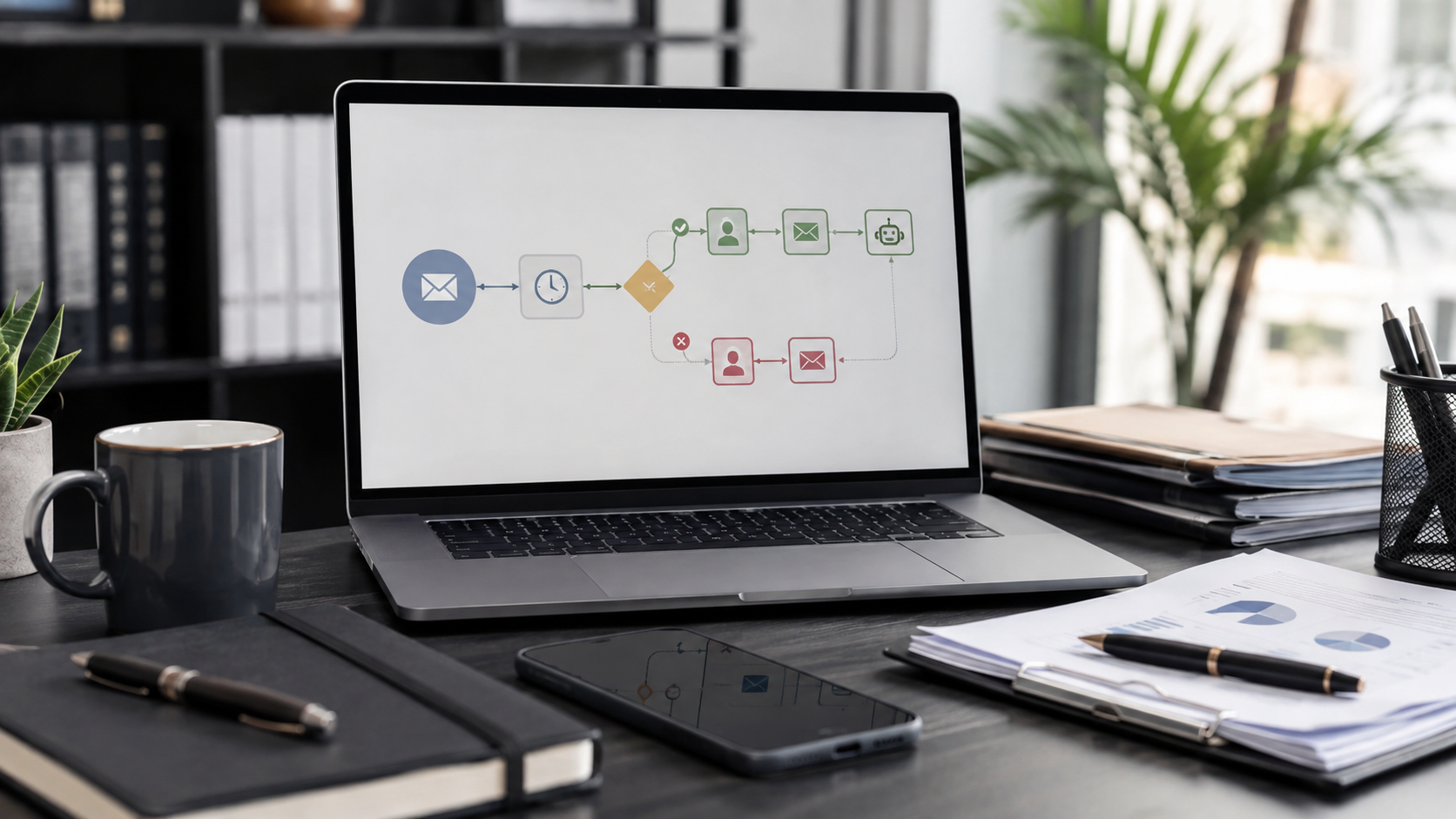
What should a simple automated follow-up sequence include?
A useful sequence should help the buyer move forward without treating every prospect as identical.
| Stage | Typical timing | Automated purpose | Human checkpoint |
| Enquiry received | Immediately | Confirm receipt and set expectations | Check fit and urgency |
| Helpful follow-up | 1–2 working days | Share relevant guidance | Personalise where needed |
| Decision support | 3–5 working days | Address a concern or show proof | Call high-value prospects |
| Next-step prompt | 7–10 working days | Invite a reply or meeting | Review price and capacity |
| Final check-in | 2–4 weeks | Ask whether priorities changed | Close or retain for later |
Timing should reflect the buying cycle.
An urgent repair enquiry, a payroll support request and a strategic consultancy project will not need the same sequence.
We also need to consider how long the prospect usually takes to decide, how many people are involved and whether the purchase depends on budgets, board approval or existing supplier contracts.
When someone replies, the automated sequence should pause and hand the conversation to the right person.
Continuing scheduled messages after a response makes our business look disconnected. It also creates a poor experience at the exact point where the prospect has chosen to engage.
How can we keep automated emails useful and compliant?
Every email should earn its place.
It should clarify the next step, answer a genuine question, provide relevant evidence or make a decision easier.
Repeated “just checking in” messages add little value.
We should keep each email focused, use one clear next step and allow sensible time between messages.
Automated emails that contain direct marketing must comply with UK data protection law and, where applicable, the Privacy and Electronic Communications Regulations.
Consent or the soft opt-in will usually be required when marketing to individuals, sole traders and some partnerships. The electronic-mail consent rule does not generally apply in the same way to corporate subscribers such as limited companies, although we must still identify ourselves, provide a valid opt-out address and comply with data protection law when personal data is used.
The ICO’s guidance on direct marketing using electronic mail explains the relevant requirements.
We should not assume that having someone’s email address automatically gives us permission to send marketing.
The rules depend on:
- Whether the message is direct marketing
- The type of recipient
- How the address was obtained
- Whether consent applies
- Whether the soft opt-in applies
- Whether the recipient is a corporate subscriber
- Whether the person has objected or unsubscribed
Where consent is relied upon, we should keep an accurate record of it.
We must also act on objections, withdrawals of consent and unsubscribe requests. Appropriate suppression records help us avoid accidentally adding people back into future marketing activity.
Who should own and review our automation?
A system still needs a named owner. That person should approve timing, manage handovers, maintain suppression records and review performance.
Without clear ownership, automated messages can continue after a prospect has replied, declined or asked not to be contacted.
The key measures are not open rates alone.
We should monitor:
- Response time
- Reply rate
- Meeting-booking rate
- Quote-to-sale conversion
- Time from enquiry to decision
- Value and margin of converted work
- Unsubscribes and complaints
- Staff time saved
- Reasons prospects do not proceed
The measure should match the problem.
If our problem is slow response, measure response time.
If our problem is wasted administration, measure time saved.
If our problem is poor conversion, review the entire sales process rather than assuming email frequency is the only issue.
Our SME business coaching helps owners connect sales systems with finances, operations, people responsibilities and 90-day priorities rather than treating automation as an isolated technology decision.
How should automation support our long-term growth?
Automation should support the business we are building, not simply relieve pressure this week.
Before increasing follow-up volume, we should ask:
- Can our team deliver more work without harming service quality?
- Will payroll rise before customer cash arrives?
- Are our margins strong enough?
- Do we have enough working capital?
- Which decisions must remain with the owner?
- Does the system provide useful management information?
- Can the process scale as roles and responsibilities change?
Our guide on how a business blueprint helps SME owners move from reaction to control explains why sales, cashflow, people and operational capacity need to connect.
Better conversion matters only when we can deliver, invoice, collect payment and protect service quality.
That is why email automation should sit inside a wider growth system.
It should help us create consistency without removing responsibility.
Conclusion
We should automate email follow-up when the process is clear, repeatable and becoming difficult to manage consistently by hand.
We should start with acknowledgements, reminders, useful resources and simple check-ins.
Our people should remain involved where value, complexity, trust or judgement matters.
The commercial test is straightforward:
Does automation help us respond faster, protect time, improve consistency and make better decisions without weakening customer trust?
When the answer is yes, automation can support stronger control.
When the process is still unclear, we should fix that first.
Talk to us to get better clarity on your next steps.
FAQs
Do we need expensive software to automate follow-up?
No. Many SMEs can begin with functions already available in an email platform or CRM.
Clear ownership and a well-defined process matter more than complexity. We should only add more advanced software when it solves a genuine operational problem.
Can we automate follow-up for older leads?
Potentially. Before contacting an older lead, we should check whether the details remain accurate, why the information is still held, whether the person has previously objected or unsubscribed, whether the proposed message is direct marketing and which data protection and electronic marketing rules apply.
Should quotes be sent automatically?
Standard documents can sometimes be generated automatically, but variable pricing, scope, margin and delivery capacity should be checked before commercially important commitments are sent. Automation should support the quoting process, not remove financial judgement from it.
How many automated emails should we send?
There is no legally prescribed or universally effective number. Three to five purposeful messages may provide a practical starting point for some SMEs, but the sequence should reflect the buying cycle, the prospect’s behaviour and the nature of the enquiry. It must stop when the recipient opts out or objects.
What should happen when a prospect replies?
The sequence should pause, the reply should reach the correct person and the CRM record should be updated. Automation should create a better human conversation, not keep the prospect trapped in a fixed journey.